
What if the most effective way to resolve your legal conflict isn’t through a solicitor’s office, but by going straight to the specialist who would ultimately argue your case? Identifying a clear legal dispute path forward shouldn’t feel like a gamble or a descent into financial uncertainty. You likely worry that costs will spiral out of control before you even understand if your position is legally sound. The traditional legal structure often feels like an intimidating maze, designed to keep you at a distance whilst the clock runs on mounting hourly rates.
We believe that transparency is the only way to build a modern legal partnership. This guide shows you how to navigate complex conflicts with professional clarity and strategic precision using the direct access model. You’ll discover how to secure a clear understanding of your legal standing and a definitive roadmap for your next steps. We will examine how a fixed-fee initial consultation provides the cost predictability you need to move from a state of uncertainty to one of informed, strategic action.
Key Takeaways
- Learn how to transition from an emotional reaction to an objective, structured strategy that prioritises your long-term legal interests.
- Understand the concept of litigation risk and why a professional merit assessment is vital before initiating any formal proceedings.
- Discover how the direct access model offers a more efficient legal dispute path forward by connecting you with a specialist barrister for immediate strategic clarity.
- Follow a clear five-step framework designed to resolve conflicts through early expert intervention rather than prolonged administrative delays.
- Gain cost predictability through fixed-fee consultations that provide a definitive roadmap for your next steps without the fear of spiralling hourly rates.
Navigating the Legal Dispute Path Forward in Ireland
When a conflict arises, your immediate focus often shifts to the problem itself rather than the solution. Identifying a clear legal dispute path forward requires a shift in mindset; you must transition from reactive conflict to a structured resolution strategy. Early intervention is not merely a preference but a financial necessity. If you wait until litigation is inevitable, you’ve already lost the opportunity to control the narrative and the costs. Strategic clarity serves as the foundation for any successful outcome, ensuring you don’t waste resources on unwinnable arguments.
Identifying the Nature of Your Conflict
The specific area of law involved dictates the expertise required for your resolution strategy. A commercial dispute involving a breach of contract requires a different tactical approach than an employment issue or a private civil matter like probate. It’s vital to distinguish between a simple disagreement and a legally actionable dispute. Whilst every conflict feels urgent, not every grievance meets the threshold for legal intervention. Identifying the specific category early allows you to match your case with a specialist barrister who understands the nuances of Irish court procedures and precedents.
The Emotional vs Strategic Response
Intense stress often triggers an impulse to explain, justify, or even apologise. You must resist this. Making admissions or commitments whilst under pressure can severely compromise your future defence. We recommend a “standstill” approach: pause all direct communication with the opposing party until you have secured expert advice. This period of silence isn’t a sign of weakness; it’s a tactical pause to assess your position without giving away your legal advantage.
During this pause, you should explore Alternative Dispute Resolution options such as mediation or arbitration, which the Mediation Act 2017 encourages as a cost-effective route. A cause of action is the specific set of facts that gives you the legal right to seek a remedy in court. If your situation lacks this foundation, no amount of emotional justification will secure a legal victory. By securing a specialist’s view early through direct access, you gain the clarity needed to decide whether to settle, negotiate, or proceed with your legal dispute path forward.
Determining the Merits of Your Legal Case
Before committing to a long-term strategy, you must determine if your claim has legal substance. A merit assessment isn’t a simple confirmation of your side of the story; it’s a rigorous analysis of how your facts align with established Irish law. This evaluation represents the most critical phase of your legal dispute path forward. A specialist barrister examines the strength of evidence rather than just the truth of the narrative. They look for what can be proven in a courtroom setting, identifying potential weaknesses that an opposing counsel might exploit. If your evidence is purely anecdotal, it’s unlikely to survive the scrutiny of a formal hearing.
You should accept that litigation risk is an inherent part of the Irish legal system. Even with the procedural oversight of The Courts Service of Ireland, no case is entirely certain. Outcomes are often influenced by the credibility of witnesses or the interpretation of complex statutes by a judge. Unforeseen testimony or the late discovery of documents can shift the momentum of a trial in an afternoon. Acknowledging this reality early allows you to make a pragmatic decision: is the potential reward worth the risk of a loss? A strategic partner helps you weigh these variables before you invest heavily in a solicitor’s hourly rates.
Gathering the Factual Bedrock
Your case is only as strong as the documents supporting it. To assist your legal counsel, you should compile all relevant materials into a clear, chronological file. Essential evidence typically includes:
- Signed contracts and written agreements
- Email correspondence and text messages
- A detailed timeline of events
- Contact details for potential witnesses
Preserving digital evidence is paramount. Don’t delete message threads or alter electronic files, as their metadata can be crucial for verification. Organising these documents before your consultation allows the barrister to focus on strategy rather than administrative sorting.
Assessing Potential Remedies
Clarity on your desired outcome is essential. If you don’t know what you want to achieve, you can’t choose the right strategy. You might seek financial compensation, specific performance of a contract, or an injunction to stop a specific action. Each goal requires a different procedural route through the District, Circuit, or High Court. You must also consider the commercial reality of the situation. If the cost of the dispute exceeds the potential recovery, a negotiated settlement might be the more intelligent path. Securing an expert merit assessment early ensures you don’t pursue a remedy that is either legally unavailable or financially illogical.
Comparing Direct Access vs Traditional Solicitor-Led Routes
The traditional Irish legal model operates on a tiered system. You typically engage a solicitor first, who then instructs a barrister to provide a specialist opinion or draft court documents. Whilst a solicitor is essential for managing the procedural mechanics of litigation, the barrister acts as the architect of the legal strategy. Choosing the right legal dispute path forward involves deciding whether you need a manager or a strategist at the very beginning of your journey. If you require immediate clarity on the merits of your case, the direct access model offers a streamlined alternative to the conventional two-tier approach.
Direct access allows you to bypass the initial administrative layer for preliminary advice. This provides a significant speed advantage. Instead of waiting for a solicitor to brief a barrister, you speak directly to the expert who would eventually argue your case in court. This direct line of communication ensures that your legal standing is assessed with precision from day one, rather than being filtered through multiple channels. It’s a modern, efficient way to secure the high-level expertise typically reserved for the later stages of a court case.
When is Direct Access Most Effective?
Direct access is particularly powerful during the early stages of a conflict. If you need a definitive interpretation of a commercial contract or a specialist view on a probate disagreement, a barrister can provide this without the need for a full solicitor firm structure. It’s an ideal tool for employment law consultations and debt recovery disputes where the core question is often one of legal merit rather than administrative volume. If formal litigation becomes unavoidable, the barrister can then refer you to a trusted solicitor to manage the court filings and correspondence. This ensures you only pay for litigation management when it’s actually necessary.
Understanding the Cost Dynamics
The cost implications of these two routes are distinct. Traditional solicitor-led models often rely on hourly rates that can range from €150 to over €450 depending on the firm’s seniority. Direct access, by contrast, frequently utilises a fixed-fee approach for the initial consultation. This transparency is a cornerstone of modern legal services in Ireland, aligning with the spirit of the Legal Services Regulation Act 2015. By removing redundant administrative costs in the preliminary phase, you can secure high-level strategic advice at a predictable price. This efficiency allows you to establish your legal dispute path forward without the fear of an open-ended bill before you’ve even decided to proceed with a claim.
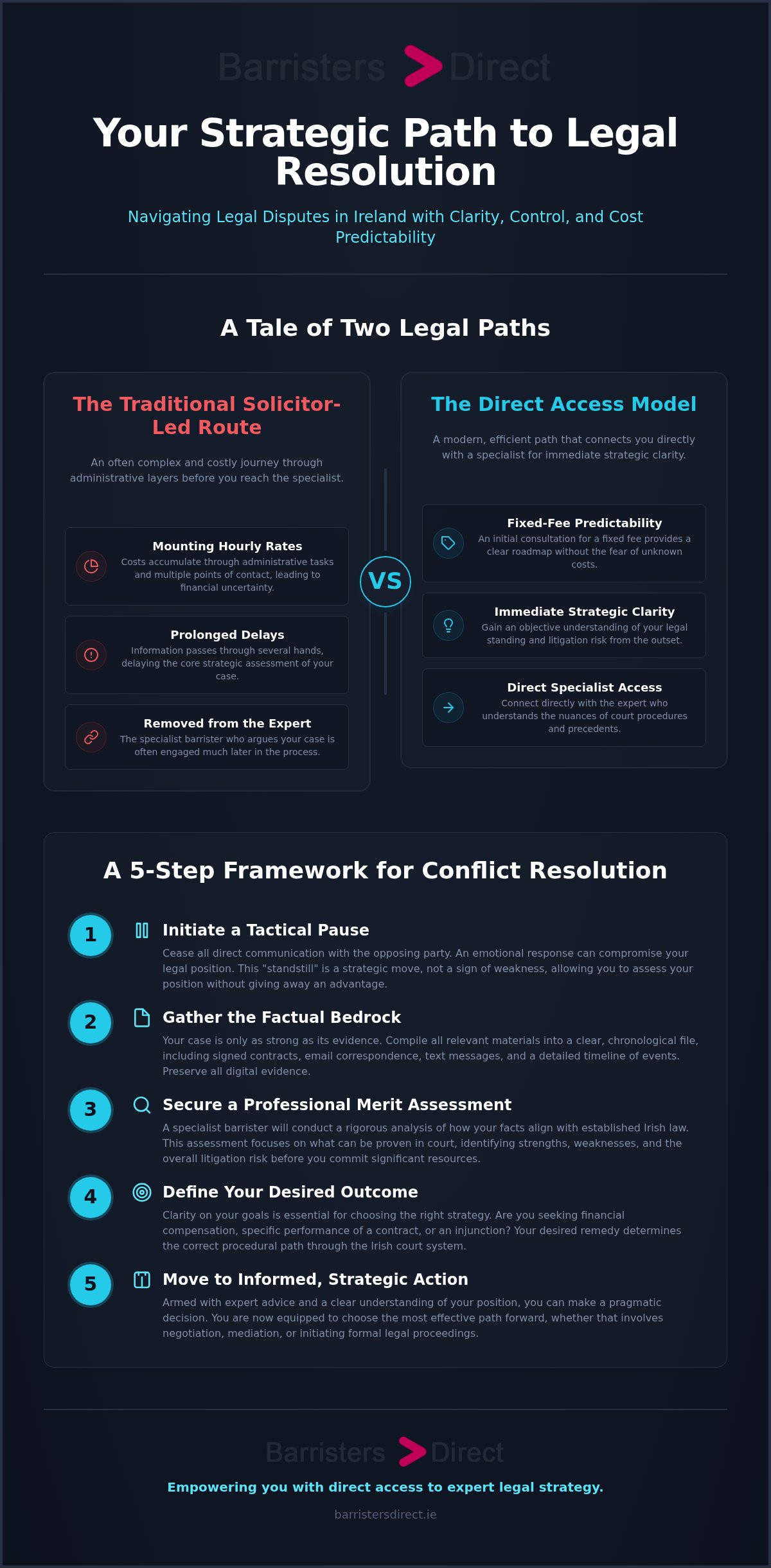
A Step-by-Step Strategy for Resolving Your Conflict
Most individuals wait until they’re drowning in administrative paperwork before seeking a specialist opinion. This delay is a significant tactical error. A successful legal dispute path forward relies on front-loading your expertise rather than saving it for the courtroom. By engaging a specialist at the start, you ensure your case is built on a solid foundation. This allows a barrister to help you “plead your case” with technical precision, ensuring your formal documents reflect the strongest possible legal arguments from the very first letter sent.
Step 1 to 3: From Audit to Expert Opinion
The first stage of any resolution is an internal audit. You should gather every relevant email, contract, and text message to establish a factual baseline. Once your records are organised, you move immediately to step two: the expert consultation. Securing a barrister’s opinion on the merits at this early stage is the pivot point for your entire strategy. It prevents you from pursuing dead-end arguments that would eventually be dismissed by a judge. Step three involves strategy formulation. Based on the expert’s view, you decide whether the most viable path leads toward negotiation, mediation, or formal litigation. Strategy isn’t a reaction; it’s a choice based on objective data.
If you’re ready to define your strategy, you can book a fixed-fee consultation to begin your step-two merit assessment today.
Step 4 to 5: Execution and Resolution
Step four is the initiation of formal communication. This often begins with a “Letter Before Action” or the opening of formal negotiations. Because you’ve already secured expert input in step two, this communication carries the weight of a prepared legal mind. It signals to the opposition that you’re ready for the next procedural tier and aren’t merely bluffing. Finally, step five is resolution management. This involves finalising a settlement or, if necessary, transitioning into the court system with a solicitor.
Alternative Dispute Resolution (ADR) options, particularly mediation, are vital at this final stage. Under the Mediation Act 2017, there’s a strong emphasis on reaching a settlement without a full court hearing. Mediation allows for a confidential, controlled environment where both parties can reach an agreement. This is often far more desirable than waiting for the 8 to 12-month delays sometimes associated with court-led conferences. By following this structured legal dispute path forward, you maintain control over the outcome rather than leaving it entirely to the discretion of the courts.
Securing Strategic Clarity with a Fixed-Fee Consultation
The Barristers Direct model provides a modern, transparent solution for anyone seeking a definitive legal dispute path forward. Traditional legal entries often involve open-ended commitments and vague estimates that leave you vulnerable to escalating costs. We replace that uncertainty with a fixed-fee consultation model. This approach allows you to secure high-level expert advice from a specialist barrister without the administrative overhead of a full solicitor-led firm. You receive a comprehensive strategic review for a single, predictable fee, ensuring that your initial investment goes directly toward legal intelligence rather than procedural paperwork.
Our platform matches your specific case with a specialist barrister from our extensive network. If your matter involves high-stakes commercial litigation or complex probate issues, we pair you with a Senior Counsel. If it’s a more straightforward debt recovery or employment issue, a Junior Counsel provides the necessary expertise. This precision matching ensures the advice you receive is perfectly aligned with the complexity of your dispute. It’s a risk-free way to secure a specialist opinion before you decide to engage in the full litigation process.
What to Expect from Your Initial Meeting
This meeting is designed to produce a clear legal dispute path forward. Your barrister will strip away the emotional layers of the conflict to identify the core legal merits. They’ll provide a frank assessment of the strengths and weaknesses of your position, helping you understand what can be proven in an Irish court. If your evidence is weak, they’ll tell you directly. If your position is strong, they’ll explain why. You’ll leave the consultation with professional confidence, knowing exactly where you stand and what your next tactical move should be. This clarity is often the difference between a successful settlement and a costly court defeat.
Taking the First Step with Confidence
Booking a consultation through our platform is a straightforward process. You simply select your area of law, provide a brief overview of your situation, and we handle the matching. There’s no further commitment required beyond this initial meeting. It’s a self-contained service designed to empower you with information. If you decide that the risks of the case outweigh the potential rewards, you’ve secured that knowledge for a fixed price rather than discovering it months later after paying thousands in hourly rates. If you choose to proceed, you’ll do so with a specialist-drafted roadmap in hand.
Book your fixed-fee legal consultation today to find your path forward.
Take Control of Your Legal Strategy
Resolving a conflict doesn’t have to be a journey into the unknown. By choosing a direct access model, you bypass traditional administrative delays and secure immediate clarity from the specialists who know the law best. You’ve learned that a successful resolution depends on an objective merit assessment and a structured, five-step strategy that prioritises professional advice at the earliest possible stage. This approach ensures you don’t waste resources on litigation that lacks a solid foundation or a clear cause of action.
We provide direct access to expert barristers from the Law Library of Ireland across all major legal areas. Our transparent fixed-fee structure removes the intimidation factor from the legal process, allowing you to focus on results rather than mounting bills. If you’re ready to move from uncertainty to action, now is the time to secure your legal dispute path forward with a specialist who understands the intricacies of the Irish court system.
Find your legal dispute path forward with a fixed-fee consultation and gain the professional precision your case deserves. You don’t have to navigate this complex system alone; expert guidance is just one step away.
Frequently Asked Questions
What is the first step in a legal dispute path forward?
The first step involves an objective internal audit of all facts and documentation. You must gather every piece of evidence, from signed contracts to email chains, to establish what can be proven. This audit allows you to present a coherent narrative to a legal professional. Once you have your facts organised, seeking a specialist merit assessment is the next logical action to determine if your claim is legally actionable.
Can I talk to a barrister in Ireland without a solicitor?
Yes, you can access a barrister directly for preliminary legal advice through the Direct Professional Access scheme. This model allows individuals and businesses to bypass the traditional requirement of engaging a solicitor first for initial opinions or strategy. If the matter eventually requires formal court litigation or the issuing of proceedings, the barrister will then refer you to a solicitor to manage the administrative and procedural elements of the case.
How much does an initial legal consultation cost in Ireland?
Costs vary depending on the practitioner’s seniority and the complexity of the matter. In Ireland, solicitor hourly rates generally range from €150 to over €450 in certain high-demand practice areas. However, a fixed-fee model provides a more predictable alternative for an initial legal dispute path forward. This ensures you receive specialist advice for a set price without the risk of an open-ended bill before you fully understand the strength of your legal position.
What is a fixed-fee legal consultation?
A fixed-fee consultation is a service where you pay a single, transparent price for a specific meeting and legal review. Unlike the traditional hourly billing model, this approach removes the uncertainty of spiralling costs. It’s designed to provide you with a clear strategic roadmap and an expert opinion on your case merits for a one-time fee. This allows you to secure professional clarity without any further financial commitment beyond the initial session.
Do I always have to go to court to resolve a legal dispute?
No, court is often the final resort rather than the first. Many disputes are resolved through mediation or arbitration. The Mediation Act 2017 actually requires legal practitioners to advise their clients on mediation as a viable alternative to litigation. These methods are frequently faster and more cost-effective, allowing parties to reach a confidential settlement without the public nature or the high costs associated with a full court hearing in the High Court.
What is the difference between a barrister and a solicitor in a dispute?
A solicitor typically acts as the primary point of contact and manages the administrative side of a case, such as gathering evidence and filing court documents. A barrister is a specialist advocate who focuses on the legal strategy, drafting complex legal arguments, and representing clients in court. In the direct access model, you engage the barrister first to secure their specialist strategic insight before deciding whether a solicitor is needed for procedural management.
How do I know if my legal case has a strong chance of success?
A strong case is built on verifiable evidence rather than just a compelling story. A barrister evaluates the strength of evidence by looking at signed contracts, contemporaneous records, and witness credibility. They also assess litigation risk, which accounts for the unpredictability of court outcomes. Securing a specialist merit assessment is the only way to gain an objective view of your chances before investing heavily in a legal dispute path forward.
What documents should I prepare for my first legal meeting?
You should prepare a comprehensive file containing all primary evidence. This includes signed contracts, a chronological timeline of events, and all relevant correspondence such as emails or text messages. If your dispute involves financial losses, include bank statements or invoices to quantify your claim. Organising these documents chronologically allows your barrister to focus immediately on the legal strategy rather than wasting time sorting through unorganised paperwork during your initial consultation.
Disclaimer
This article does not constitute legal advice. Barristers Direct does not provide legal advice. To obtain legal advice, you should contact a legal practitioner.